Julius Enderby
The Caves of SteelJulius Enderby is New York City’s police commissioner, Elijah Baley’s friend and superior, and ultimately the accidental killer of Roj Nemennuh Sarton. His polished office, familiar manner, and reliance on Baley’s loyalty help conceal a fatal mistake: unable to distinguish Sarton from the robot he resembles, Enderby shoots the wrong man, then tries to divert the investigation and implicate Baley.
Identity and Position
Enderby’s office announces his position in carefully etched lettering on clouded glass: Julius Enderby, Commissioner of Police, City of New York. He wears spectacles because, as Baley is told, his eyes are sensitive and cannot tolerate contact lenses. Baley privately suspects that Enderby values the glasses partly for the character they lend his otherwise unremarkable face. The spectacles are more than a visual signature: when they break, they become central to the confusion that leads to Sarton’s death.
Enderby’s authority sits at a difficult boundary between local policing and interstellar politics. Although Spacetown lies within New York City’s limits, the Spacers possess extraterritorial rights and can insist on conducting their own inquiry. Enderby says he has spent the three days after the murder conferring with the Mayor, visiting Spacetown, and speaking in Washington with the Terrestrial Bureau of Investigation. The federal view, he reports, is that the case belongs to the City because the killing occurred within its jurisdiction; the Spacers’ special rights nevertheless leave them powerful leverage.
The Case and Baley’s Assignment
Enderby appoints Baley, a C-5 detective, as operative in charge of the investigation. He presents the assignment as both an opportunity for Baley to earn a C-6 rating and a personal appeal between old friends. Their familiarity is real, but it also gives Enderby a means to place an investigator he believes will trust him at the center of the case. He asks Baley to accept a Spacer partner as a condition of the Spacers’ agreement not to report the murder and to leave the investigation in City hands. Their agent is to take part throughout, not merely receive a final report.
The political stakes make the arrangement more than routine cooperation. Enderby warns that the Outer Worlds might use the murder to demand indemnities, while refusing payment could bring its own political cost. He argues that mishandling the case could hasten the day when City residents lose confidence in their future and their pension-tab booklets; a successful investigation, by contrast, might postpone that day. His account frames the assignment as both a matter of public consequence and a chance for Baley personally.
Enderby’s conduct during the inquiry repeatedly places him in the role of concerned superior. When Baley speaks to him by three-dimensional communication from Spacetown and announces that he has penetrated the mystery of Sarton’s death, Enderby springs to his feet and catches his spectacles as they fly. The reaction briefly appears to be comic nervousness. In retrospect, the spectacles and his response to the announcement point toward the moment when the case’s apparent victim and its supposed robotic counterpart will prove fatally confusable to him.
Friendship, Suspicion, and the Investigation
Enderby’s friendship with Baley is both a genuine bond and, as Baley later concludes, a source of leverage. Baley regards the Commissioner as a familiar figure associated with the safety of the City; after seeing Enderby appear on a communications screen in Spacetown, he feels an intense longing to be back in the City and in the Commissioner’s office. That attachment helps explain why Baley initially has difficulty treating his old friend as a suspect.
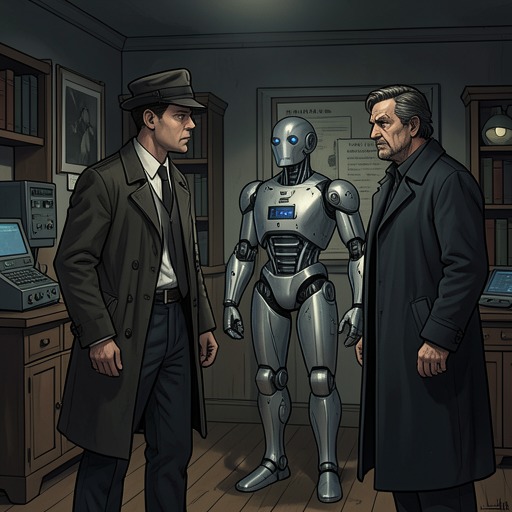
The investigation also exposes the unequal legal standing of its participants. Baley points out that R. Daneel Olivaw’s testimony would not carry legal weight on Earth if Daneel disclosed that he was a robot: robots have no status as witnesses in an Earth court. Yet when Baley later confronts Enderby, Daneel’s capacity to communicate with Han Fastolfe gives the accusation political force. Enderby cannot simply dismiss Baley while Spacetown may hear the exchange and report its account to the Outer Worlds. The case therefore turns not only on what can be proved but on which institutions can make the proof consequential.
Enderby is not above reproach even before Baley identifies him as the murderer. He rebukes Baley for what he calls a major blunder during the confrontation in Spacetown. Later, when Baley returns to the Department, Enderby directs him to get something to eat but insists that he remain inside, and stresses that the investigation needs a motive. He avoids addressing Daneel by name. The exchange initially sounds like a supervisor keeping the inquiry focused; Baley’s growing suspicion gives the insistence and avoidance a different significance.
Exposure and the Mistaken Killing
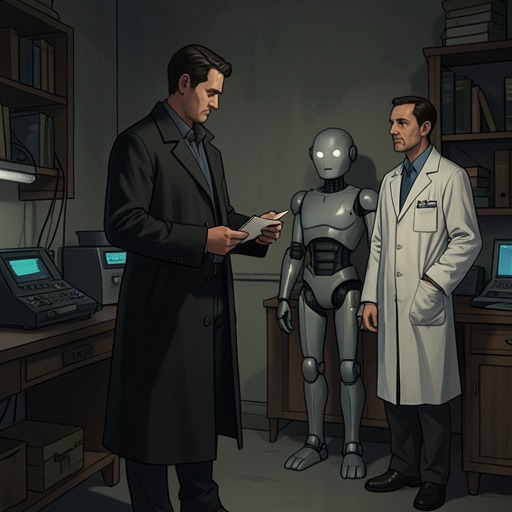
Enderby’s plot against Baley becomes explicit when Baley confronts him at the Department. Baley says that Enderby visited the Williamsburg power plant and obtained the Alphasprayer used to destroy R. Sammy, then gave it to the robot. Baley also accuses him of arranging for Dr. Gerrigel to be directed by a deliberately maladjusted guide rod to the room containing R. Sammy’s remains, expecting the scientist to identify them correctly. The destruction and discovery would implicate Baley and impede the Sarton investigation. Enderby denies the accusation, suspends Baley, demands his credentials, and declares him under arrest; Baley, desperate to finish his explanation, refuses to hand over his weapon before he has been heard.
Baley’s account of Enderby’s motive connects the attempted frame-up to the original assignment. Enderby chose him, Baley says, because their college friendship and Baley’s loyalty made it unlikely that he would suspect a respected old friend. He also expected to exploit Baley’s knowledge that Jessie had joined a Medievalist organization, either to remove Baley from the case or to silence him if he came too close to the truth. Enderby knew about Baley’s father’s declassification and could anticipate his reaction to the investigation. Most importantly, placing a trusted subordinate in charge of the murder inquiry allowed the murderer to influence the investigation from within.
The decisive clue is Enderby’s broken spectacles. Baley links them to the Commissioner’s recurring habit of taking them off and wiping them when nervous. At Sarton’s dome, Baley argues, Enderby dropped and broke them just as a figure resembling Daneel appeared. Without his glasses, Enderby could not tell the robot from Sarton, whom Enderby shot. He fled believing he had killed Daneel; the body discovered was Sarton, the man whose likeness had been used in Daneel’s design. The broken glasses thus explain both the accidental nature of the killing and why Enderby’s initial account of the case concealed the truth.
Admission and Aftermath
Daneel initially objects that Baley’s theory is untenable, but changes his assessment after examining the evidence and recognizing that Enderby’s cerebroanalysis had diverted him from the truth. As the day turns to midnight, Enderby lowers his head and says that it was a mistake and that he never meant to kill Sarton. He collapses from his chair, prompting Daneel to tell Baley that he has hurt the Commissioner. Enderby is alive, and the revelation changes the case from a search for an intentional killer into an account of a fatal misidentification followed by deliberate obstruction.
Enderby asks whether he will be prosecuted. Baley does not promise immunity; he tells him that he will not be prosecuted if he helps. Enderby, in tears, agrees and insists that the shooting was an accident and that he believed he was doing what was right. Baley directs him to begin by quashing the R. Sammy matter and warns that Spacetown already knows the truth, so removing Baley would ruin Enderby rather than contain the accusation.
Baley also urges Enderby to recognize space colonization as Earth’s only possible salvation and to act without prejudice, suggesting that he speak with Fastolfe if he cannot accept the argument. The proposed resolution is therefore conditional rather than absolving: Enderby’s accidental killing remains the cause of the case, and his attempt to manipulate its investigation remains a separate responsibility. His cooperation can help end the frame-up and support the larger case for Earth’s future, but friendship no longer shields him from exposure.